Pulse calibration is the determination of the length a radio frequency pulse (pulse width)of a certain power has be be applied to rotate magnetisation of a nucleus by a specific angle. Usually this is the determination of the pulse width of the 90° (π/2) rotation required to move the magnetisation into the transverse plan and therefore give maximum detectable signal.
The 90°pulse length will depend on the nucleus involved, power level, spectrometer, probe and sample conditions.
For proton pulse length determination a simple pulse sequence is used involving a single excitation pulse followed by acquisition (zg pulse sequence on a Bruker spectrometer).
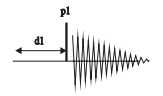
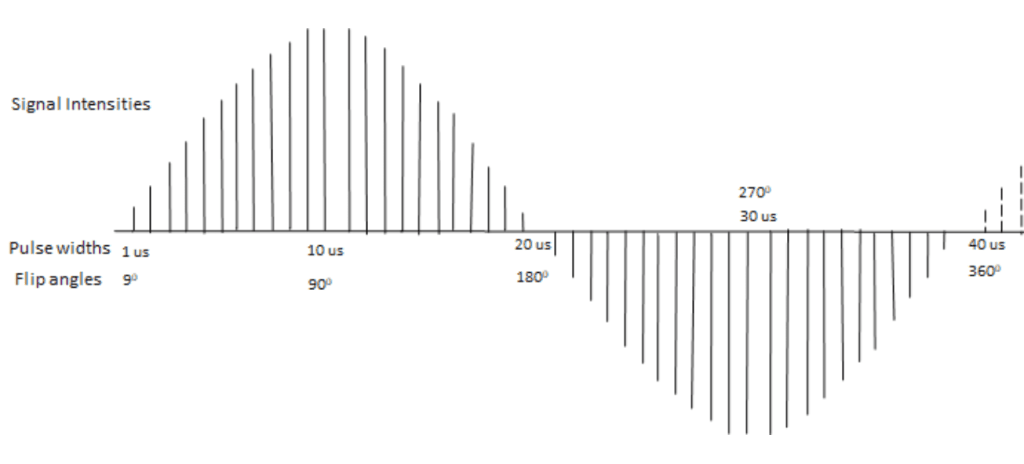
The pulse duration applied is varied to detect a null signal corresponding to the 360° pulse. The resulting value for the 360° pulse is dived by 4 to give the 90° pulse length.
This can also be done using more automated methods (such as the Bruker pulsecal command) especially in automated spectral acquisition.
Previous: Shimming
Next: Solvent Suppression

