
Solvent Suppression
Usually in a solution NMR sample the most concentrated component in the NMR tube is the solvent. Often this is not of interest and the large signal from the solvent must be suppressed to allow the weaker signals from the analyte to be clearly detected. Often for biological signals this involves the suppression of the water signal but the same factors apply regardless of the solvent. Using D2O in place of H2O will mask the signals from the water as the deuterium signals do not appear in a proton NMR spectrum. However, some H2O contamination of D2O is always present so the residual signal from H2O will need to be dealt with. Also using pure D2O is not always helpful as due to exchange with the solvent some signals will disappear (such as the peptide amide signals). Below is a list of some of the emthods that can be used to selectively suppress the solvent signal.
Presaturation
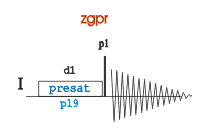
Presaturation is the application of a long low-power selective radio frequency pulse on the solvent resonances. The effect of this is to saturate the water resonance so that any subsequent hard pulse have no effect of the solvent nuclei as there is not net magnetisation. Due to the low power and long pulse duration the frequency range covered by the saturation can be small meaning only the solvent peaks and those resonances very close to the solvent peaks will be affected. Increasing the power level of the saturation pulse will increase the frequency range affected. This saturation is generally performed at the start of a pulse sequence but can also be applied during some delays such as the mixing time of a NOESY experiment.
WATERGATE
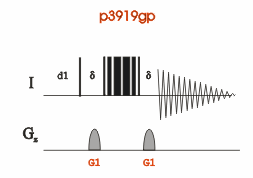
WATERGATE (water suppression by gradient-tailored excitation) (Sklenar, et al. Journal of Magnetic Resonance, Series A 102.2 (1993): 241-245) uses selective 180° pulses (generally in the form of a binomial 3-919 sequence) to invert all non-water signals together with pulse field gradients to dephase solvent magnetisation and rephase analyte magnetisation. Provides superior solvent suppression to presaturation and is easily integrated into multidimensional NMR experiments.
Excitation Sculpting
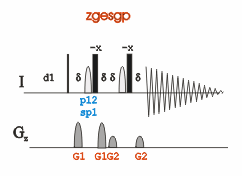
Excitation sculpting uses a solvent selective double spin echo to which effectively depahses solvent magnetisation and rephases signals of interest using a combination of non-selective hard pulses and selective soft pulses. It results in a flat baseline with minimal phase distortions. Like the WATERGATE sequence it can be easily incorporated into many different pulse sequences.
Flip Back Pulses
Flip back pulses are a technique that manipulates magnetization, particularly of water protons, to enhance sensitivity and speed up experiments by selectively “flipping” magnetization back to equilibrium.

