Nuclear Precession and Signal Generation
Due to quantum mechanics nuclei will not align directly with or against the magnetic field.
Instead they will be at an angle and will precess around an axis defined by the external magnetic field. This is analogous to a spinning top in the Earth’s gravitational field

The rate of this precession depends on the nuclei involved, the size of the external magnetic field and the local chemical environment of the particular nucleus.
The distributions of magnetic moments of the nuclei gives a small excess aligned with the magnetic field over those aligned against. The result is a net magnetisation aligned with the magnetic field.
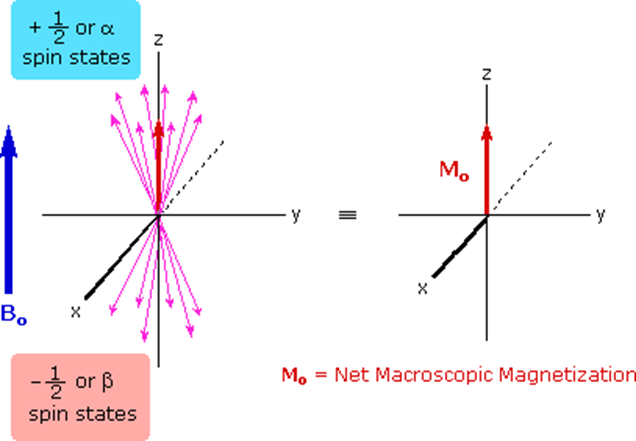
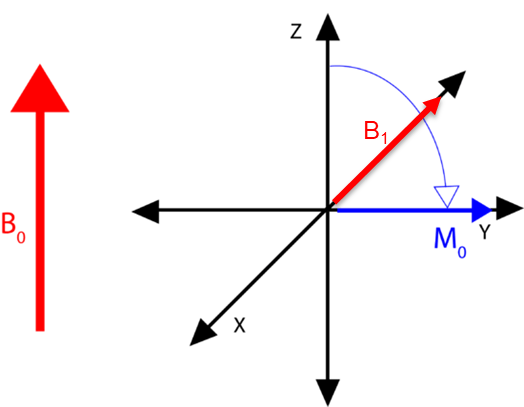
A radio frequency pulse matching the rotational frequency of the nuclei is applied 90° away from the bulk magnetic field (B1). The RF pulse is then stopped when the net magnetisation has rotated 90°. In this case the B1 field is applied along the -x axis so that the magnetisation rotates towards the y axis where the detector lies.
The nuclei then relax back to where they began during which they rotate around the axis of the bulk magnetic field.

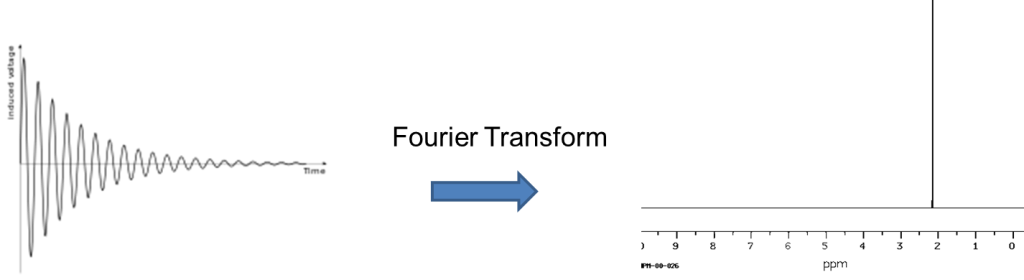
As the nuclei have a magnetic moment they will generate a current in the coil giving a sinusoidal curve which decays back to zero. This is the Free Induction Decay (FID). The FID is the converted from a time domain to a frequency domain using the Fourier Transformation.
Previous: Nuclear Spin
Next: Chemical Shift

