
A 1D NMR spectrum is the result of the Fourier Transform of free induction decay (FID) which is recorded during the acquisition period at the end of a pulse sequence with the result being a spectrum with one frequency axis and one intensity axis. A 1D NMR spectrum consists of two major sections, preparation and detection. Multidimensional spectra introduce new sections, evolution time and mixing time. The addition dimensions are achieved by indirectly detecting additional time domains created by variation of delays in the pulse sequence. This is the evolution time. Magnetisation that has been created during the preparation period and frequency encoded during the evolution time is converted into a different form of magnetisation that is then detected in the FID. This conversion is achieved using interactions (such as scalar couplings or dipolar couplings) between spins in the sample and is known as the mixing time.
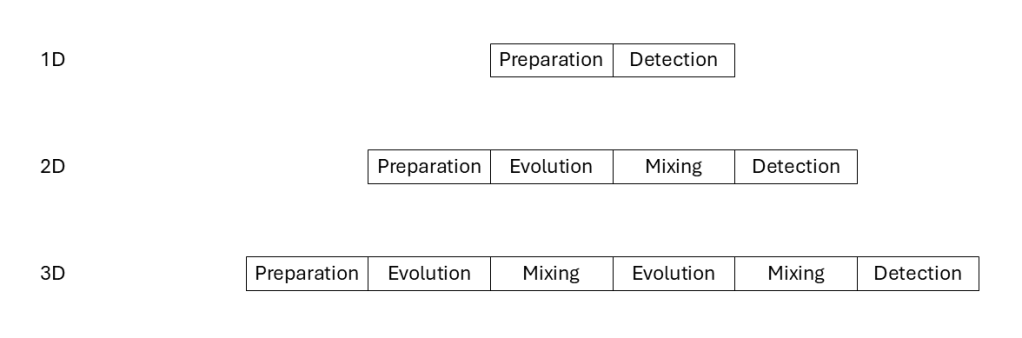
So a 1D experiment consists of a preparation step and a detection step. A 2D experiment consists of preparation, evolution, mixing and detection steps. A 3D experiment is a concatenation of two 2D experiments with two evolution and two mixing sections.
For example a simple 1D pulse sequence and a 2D NOESY are shown below.
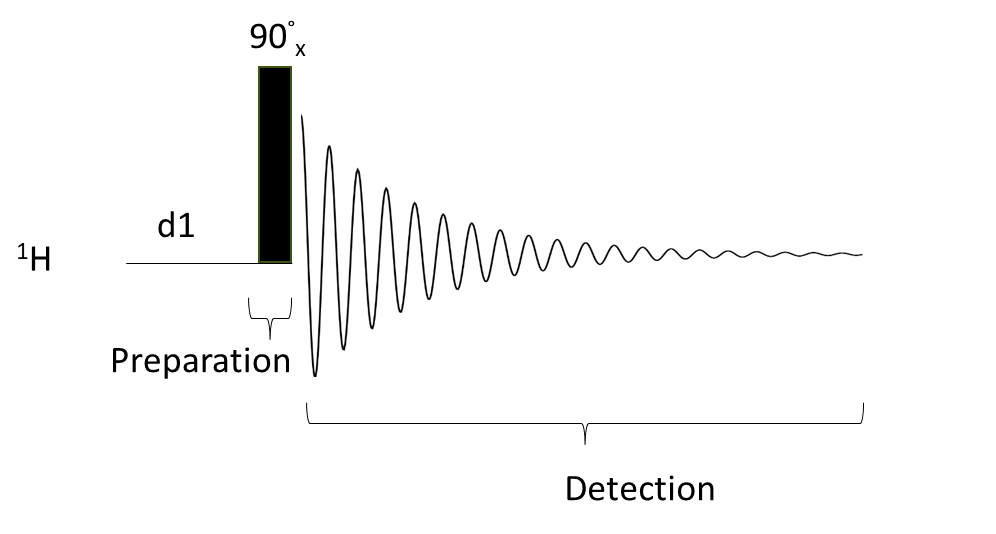
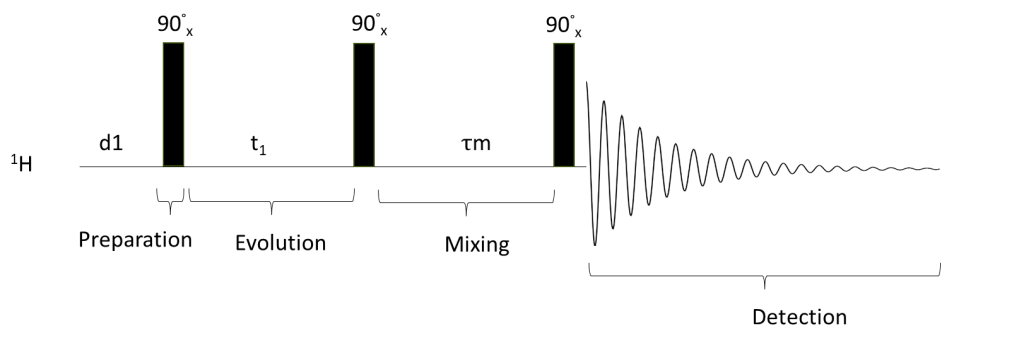
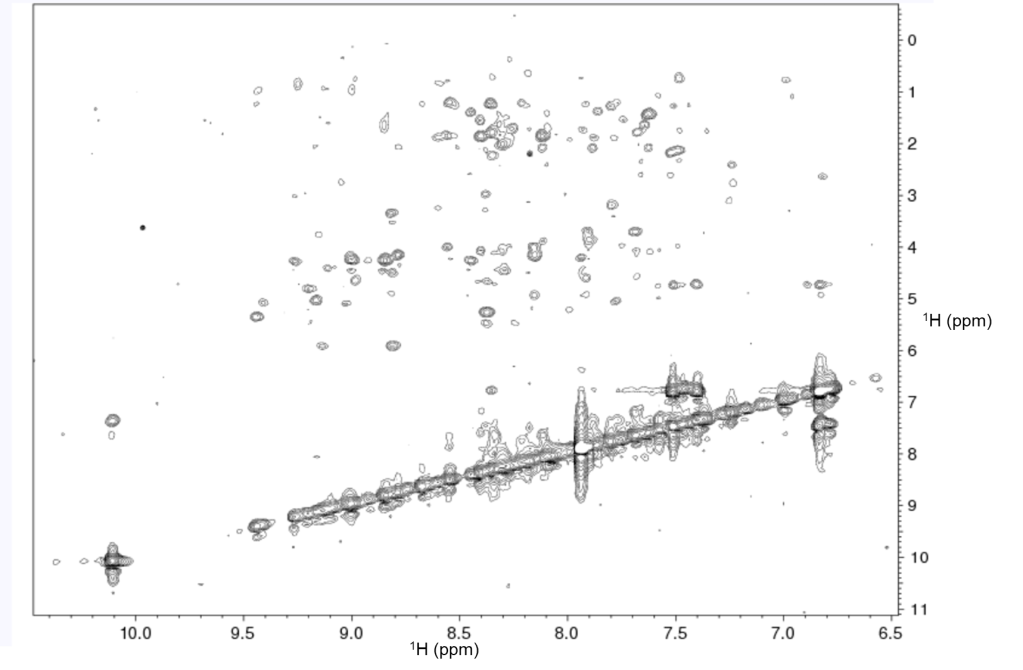
With the 2D NOESY spectrum we have a preparation step consisting of a 90° hard pulse to get magnetisation into the transverse plane. An expanding evolution period (t1) which generates our indirect dimension. A further 90° pulse to return magnetisation onto the z-axis. A mixing period to allow the nuclear Overhauser effect (NOE) to develop. A final 90° pulse puts magnetisation back into the transverse plane where detection occurs generating the direct dimension. The result is an experiment encoded with two proton dimensions giving cross peaks which denote NOEs between the two protons.
Previous: Product Operator
 HWB-NMR online NMR theory