Molecular Interaction Studies using NMR
NMR is an incredibly useful tool in studying molecular interactions. These studies can take many forms including experiments where differences in the NMR spectra of small ligands are studies to ones where the large biomolecules themselves are observed.
Ligand Observed experiments
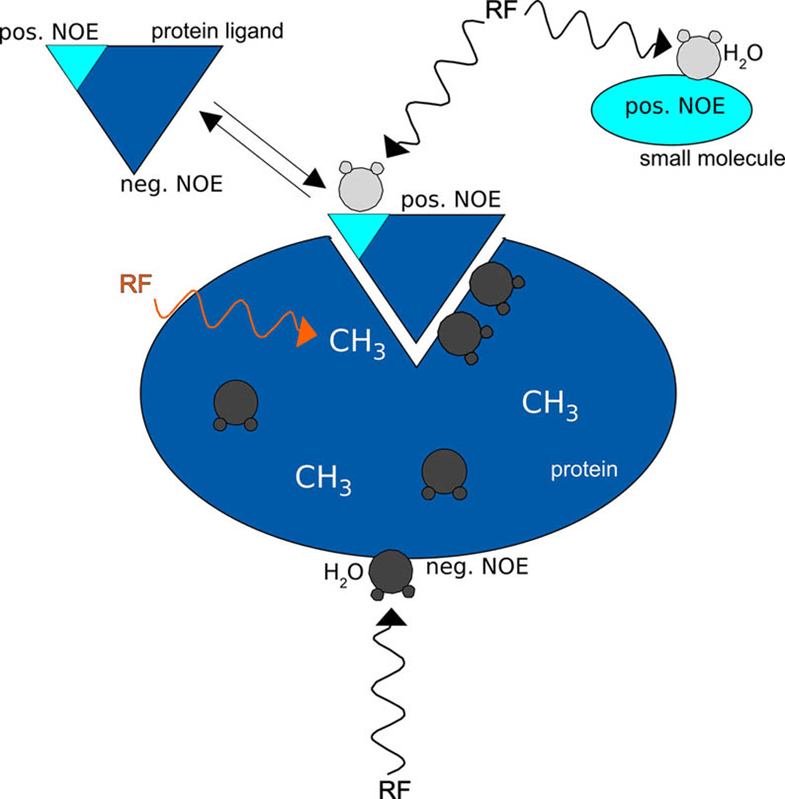
Taken from Ludwig & Gunther. Front. Biosci. 2009, 14, 4565-4574
For the STD-NMR experiment protein resonances (usually methyl groups) are saturated selectively without affecting resonances of the ligand. Saturation is shown by the dark blue tones. This saturation is transferred from the protein to any bound ligand.
Molecules which bind to the protein and are released show reduced signal intensities as a consequence of saturation transfer. Non-binding molecules show no affect.
In the WaterLOGSY experiment magnetization is transferred from bulk water to the protons of the protein by NOE or by exchange of labile protons. Ligands that do not interact with the protein show a positive NOE whilst those molecules that have bound to the protein and have been release will show a negative NOE.
Relaxation methods can also be used to study protein ligand interactions. The ligand will show increased transverse relaxation rates if they interact with the protein giving rise to increased R2 values.
Protein Detected Experiments
There are several ways of investigating interactions involving biomolecules. One of the most common chemical shift perturbations. Here upon binding the chemical environment around the nuclei of changes causing alterations in the resonance frequency which can then be mapped to identify binding sites or sites of conformational change.
Exchange rates
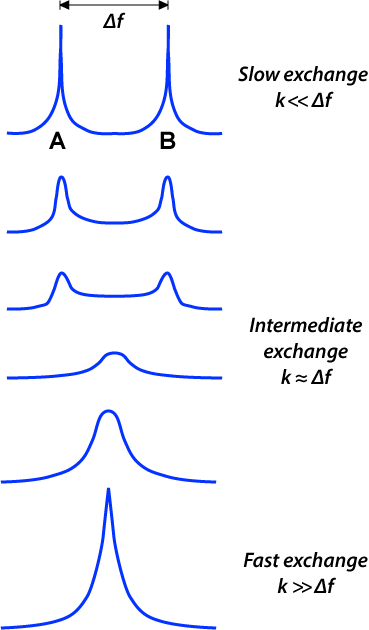
Chemical exchange rates are critical in NMR studies. In the case of molecular interactions this involves the exchange rate between sates when the molecules are free and when they are bound. If the exchange rate between the two states is significantly greater than the difference between the resonance frequencies (in Hz) of the two states then the nuclei is in slow exchange and two resonances will be seen, one at the position of the free form and one at the position of the bound form. Conversely if the exchange rate is significant larger than the frequency difference between the resonances of the two states then the nuclei is in fast exchange and a single peak is seen with its position being a weighted average based on the population ratio of the two states.