J-Coupling
NMR active nuclei which are connected through bonds have an effect on the NMR signals of each other. This is called J-coupling (also known as scalar coupling). It is due to an indirect interaction between the two nuclear spins and the local electrons. It provides information about bond connectivity as well as bond distances and angles. Coupling is also what is responsible for the splitting of NMR signals. Scalar coupling is a frequency difference given in Hz and is independent of magnetic strength.
Splitting due to Homonuclear Proton-Proton Couplings
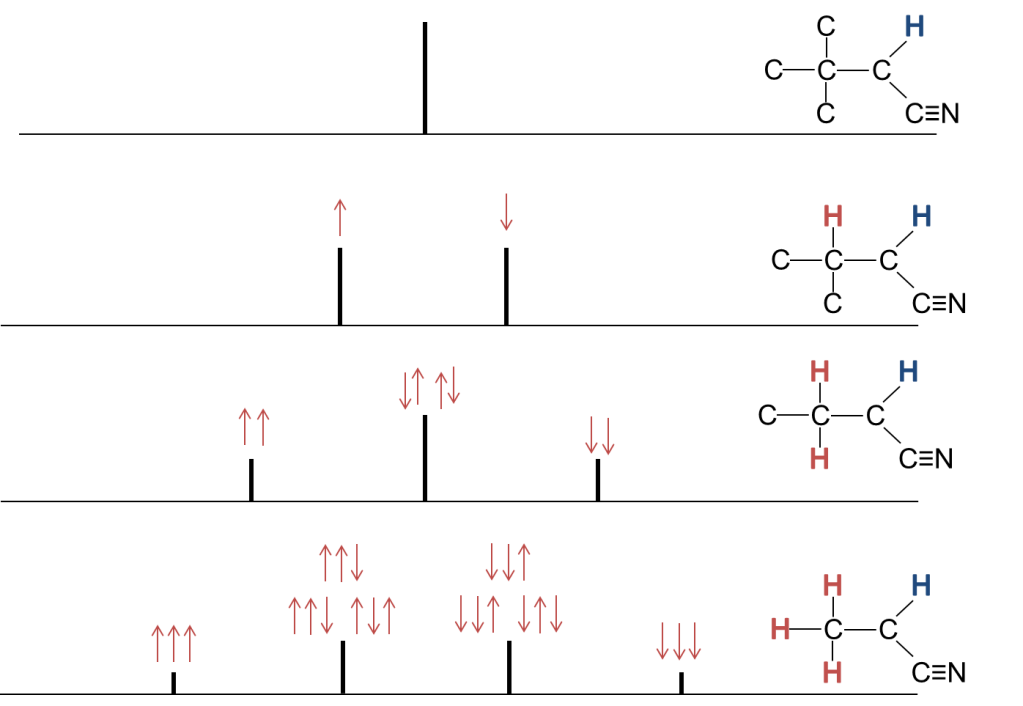
The signal from the proton coloured blue is dependent on the number of protons on the adjacent carbon. If there are no protons then the signal is not split. If there is one proton on the adjacent carbon then the signal is split into two (one for the population of the red proton that is aligned with the magnetic field and one for the population of the red proton aligned against the bulk magnetic field). The intensity of each signal is half that of the unsplit signal. If there are two protons on the adjacent carbon the the result is a triplet with the middle signal being double the intensity of the outer two. Again the sum of the intensities of all three peaks is equal to the intensity of the singlet where there are no protons on the attached carbon. With three attached protons on the adjacent carbon the result is a quartet with the centre two peaks having three times the intensity of the outer two peaks.
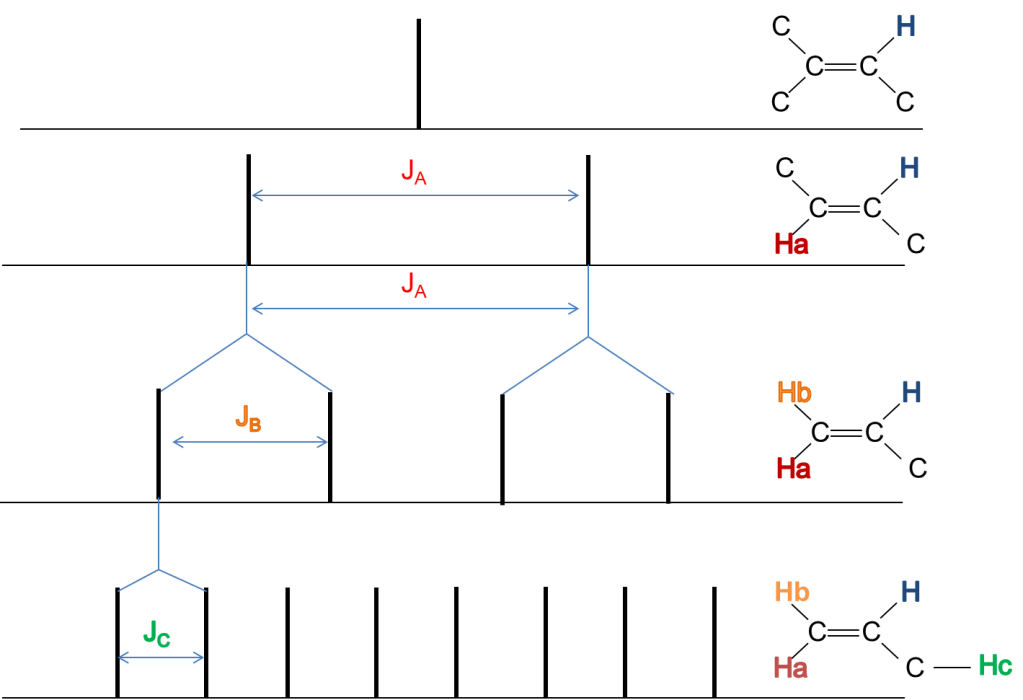
Where the protons on attached carbons are not equivalent the couplings constants may be different which leads to complex splitting patterns.
Heterononuclear Coupling in Proteins
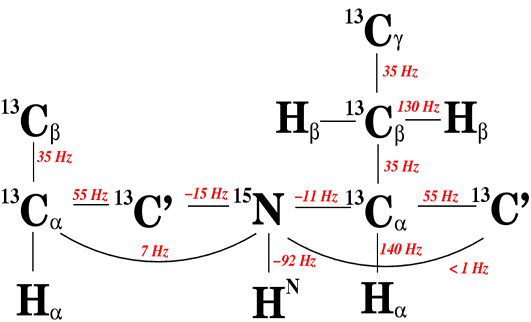
J-Couplings occur between all NMR active nuclear that are connected through bonds. The magnitude of coupling is related to the proximity of the coupled partners, the magnetic moments of the two partners and the dihedral angles involved. These couplings can vary significantly in magnitude as can be seen it the coupling constants seen between nuceli in within proteins that have been isotopically labelled with 13C and 15N. These couplings can be used to transfer magnetisation between nuclei specifically based on the magnitude of the coupling constants.
Previous: Chemical Shift
Next: The Vector Model

